
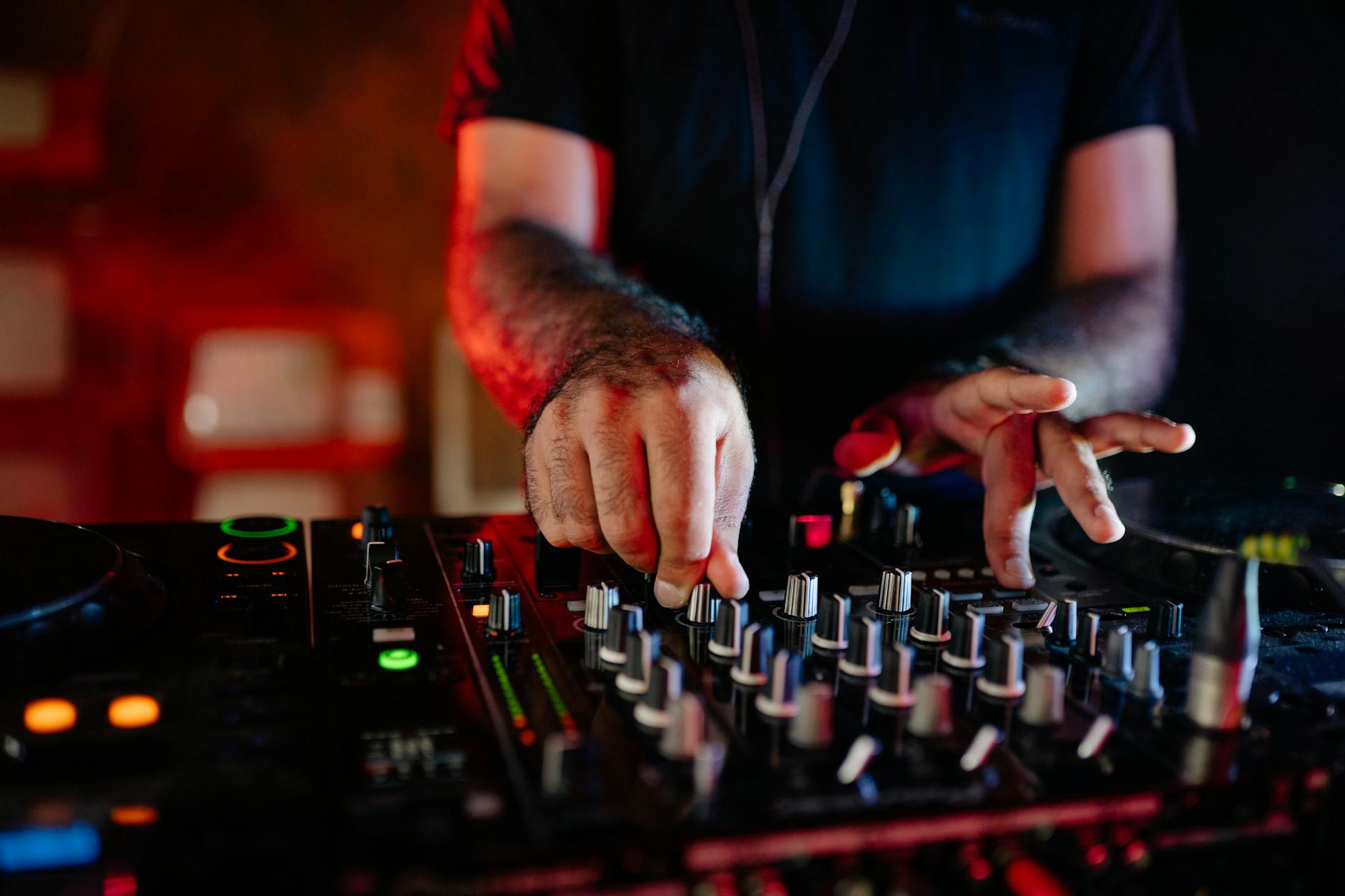
Beat matching is setting two tracks to the same tempo and aligning their kicks so they land at the same instant for as long as they play together. A DJ can beat match by ear, with waveforms, or with the sync button. All three sound the same to a dance floor. Phrase matching and key matching are what make the blend work.
What is beat matching?
Beat matching is the DJ technique of playing two tracks at the same BPM with their downbeats aligned, so the kicks of both tracks hit together during a blend. The definition fits on a coaster: two tracks, one pulse. Wikipedia's beat matching entry gives the textbook version.
A DJ can beat match three ways: by ear, by watching waveforms in Serato DJ Pro, rekordbox or Traktor Pro, or with the sync button, where the software matches the tempo. Done correctly, all three produce the same sound. The dance floor hears the result, not the method.
How do you beat match by hand?
To beat match by hand, a DJ sets the BPM with the pitch fader, aligns the downbeat with the jog wheel, then rides the pitch fader to keep the two tracks locked:
- Set the BPM. Move the pitch fader of the incoming track until its BPM equals the BPM of the track already playing.
- Align the downbeat. Nudge the jog wheel (or drag the waveform in software) until the first kick of the incoming track lands on a kick of the playing track.
- Ride the pitch fader. Make small corrections to keep the two tracks locked, then blend with the crossfader or channel faders.
Cue points speed up step 2. A cue point is a marker a DJ sets on a track during preparation, for example on the first beat of the intro or on the drop, so the DJ can start the track from that exact point in the booth.
The hardware changes how easy the three steps are (pitch fader resolution, jog wheel feel, screen size), not the steps themselves.
What BPM do common DJ genres play at?
Common DJ genres play in these approximate BPM ranges: hip-hop at 70 to 110 BPM, reggaeton at 88 to 105, house at 118 to 128, techno at 125 to 140, trap at 130 to 150, and drum and bass at 170 to 180.
| Genre | Approximate BPM range | |---|---| | Hip-hop | 70 to 110 | | Reggaeton | 88 to 105 | | House | 118 to 128 | | Techno | 125 to 140 | | Trap | 130 to 150 (half-time feel of 65 to 75) | | Drum and bass | 170 to 180 |
New releases can sit outside those ranges. In the Bangerz Army NEWS shelf on 7 November 2026, the 23 Afro House tracks among the 50 most popular additions of the previous seven days ran from 120 to 126 BPM (ten of them at exactly 122), and the 14 Tech House tracks ran from 127 to 132 BPM, faster than the classic house range.
How do you beat match two tracks with very different BPMs?
To beat match two tracks with very different BPMs, change the tempo in steps or blend on a section without drums. Going from a Tech House track at 130 BPM to an Afro House track at 122 BPM means slowing the music by about 6%. Three ways to make that jump:
- Bridge with a track in between, for example at 126 BPM, and move the tempo a few BPM per transition.
- Ride the tempo down during a breakdown, where the change is hard to hear without a kick.
- Cut on a phrase boundary and start the new track at its own tempo, which works when the drop of the new track carries the room.
Is using sync cheating?
No. The sync button is a tool, and at a paid gig it frees the DJ for the work the crowd can hear. Beat matching by ear builds timing, and the place to build it is practice at home. In the booth, the DJ also reads the room, chooses the next track, works the EQ and handles requests. Sync takes the tempo math off that list.
Manual beat matching was a gatekeeping skill when the gear could not help. The gear helps now, so the skill moved to track selection: a DJ who pulls the wrong track at 1:47 AM clears the floor whether the beats were matched by ear or by sync.
What is phrase matching?
Phrase matching is starting the incoming track on a phrase boundary of the playing track, so the sections of both tracks change at the same moment. A phrase in 4/4 dance music is typically 16 or 32 bars, and tracks are built from phrases: intro, verse, build, drop, breakdown, outro.
Beat matching aligns kicks; sync does that well. Phrase matching aligns structure: the end of the outro phrase of track A meets the start of the intro phrase of track B, so the breakdown of A resolves into the build of B. A blend started mid-phrase puts the new vocal on top of the old one, and the floor notices the seam.
Beat matching is the minimum. Phrase matching is the craft.
How do you phrase match in DJ software?
To phrase match in DJ software, count the bars on the waveform and start the incoming track so its first phrase begins when the playing track's phrase ends. Serato DJ Pro, rekordbox and Traktor Pro all mark the downbeat and the bar count on the waveform; rekordbox can also detect phrases and label them. The hard part is choosing which phrase boundary to use while the next track is cued and the current one is 16 bars from its outro.
Tracks with DJ intros make phrase matching easier, because an intro version opens with a beat-only section of whole phrases to mix in over. Of the 50 most popular tracks added to the Bangerz Army NEWS shelf in the seven days to 7 November 2026, 41 came with an Intro version. Two tracks at the same tempo can still clash when their phrase structures fight, as a 122 BPM tech house phrase often does against a 122 BPM trap phrase.
What is key matching in DJing?
Key matching, also called harmonic mixing, is choosing the next track in the same musical key as the playing track, or in a related one, so the two blend without a clash. Two tracks at the same BPM do not always blend; two tracks in compatible keys usually do.
The standard notation is the Camelot wheel, which numbers the 24 musical keys from 1A to 12B on a clock face (A for minor keys, B for major keys). Tracks with the same Camelot code blend smoothly. A move of one step (8A to 9A, or 8A to 8B) adds a slight lift. A jump of more than one step usually clashes. Wikipedia's harmonic mixing entry maps the wheel to the circle of fifths.
Minor keys dominate current club releases: 48 of the 50 most popular tracks added to the Bangerz Army NEWS shelf in the seven days to 7 November 2026 were in an A (minor) key, most often 8A, 9A and 11A. A DJ mixing those releases spends most of the night on the inner ring of the wheel.
Serato DJ Pro, rekordbox and Traktor Pro detect key on import and can show it in Camelot notation. Detection is reliable on clean studio tracks and less reliable on live recordings, so check the key by ear when a blend sounds wrong.
Break the key rule on purpose when the floor wants energy more than smoothness: a key jump on a peak-time drop reads as escalation. Mix in key by default, and break it deliberately.
How do you practice beat matching for paid gigs?
To practice beat matching for paid gigs, train on the conditions of a real gig: try transitions you have never done, practice on the gear you will play, record every set, and practice reading the floor.
- Practice transitions you have never tried. A tempo jump, a key clash or a genre change on unfamiliar tracks builds more skill than repeating a blend that already works.
- Practice on the gear you will play. A club with Pioneer DJ CDJs in the booth needs practice on CDJs, not only on a controller. Many clubs let a DJ come in early to try the booth if asked.
- Record every set and listen back the next day. Blends that felt clean in the booth often are not, and blends that felt rough often sound fine. The recording is the training data.
- Practice reading the floor. At 11:47 PM someone will request "September" by Earth, Wind & Fire. Have it tagged and cued, and land it on the next phrase boundary.
Frequently asked questions
Is beat matching by ear still worth learning in 2026?
Yes, because a trained ear hears when two tracks drift apart. That skill catches the moments sync gets wrong, most often when the software reads a track at half or double its real tempo after a confusing intro.
How long does it take to learn beat matching?
Manual beat matching on steady 4/4 tracks comes with focused practice over weeks, not years. Phrase matching takes longer, because it is pattern recognition built over many real sets. Sync removes most of the manual stage, so that practice time can go to phrase matching instead.
Do I need a controller to learn beat matching?
Software alone teaches the concepts: BPM, cue points, EQ and phrase counting. A controller or CDJ teaches the hands, because a pitch fader, a jog wheel and EQ knobs feel nothing like a mouse. For paid gigs on club gear, move to a controller early.
What is the difference between sync and beat matching?
Beat matching is the result: two tracks at the same tempo with aligned downbeats. Sync is one way to get that result, where the software does the tempo math. Manual beat matching is another, and a hybrid (manual tempo, sync-assisted alignment) is a third. The dance floor hears the result, not the method.
Building the library those tracks come from? Read how to build a DJ music library. More guides for working DJs are on the Bangerz Army blog, and the Bangerz Army DJ pool is where the intro versions live.
Image credits. All photos via Pexels under the Pexels free-to-use licence. Hero: Yan Krukau. Inline 1: Ivan Mudruk. Inline 2: cottonbro studio. Inline 3: RDNE Stock project.